
®
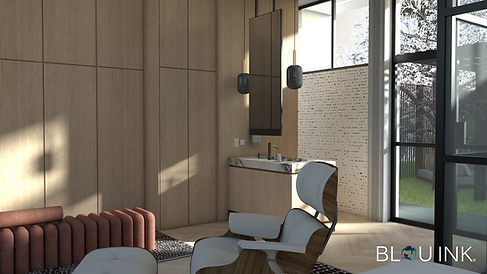
Spatial Psychology
Design for the way life is experienced.
Space does more than surround us. It influences how we move, focus, rest, connect, and experience the world around us.
BLOU INK applies Spatial Psychology to residential design, examining the relationship between environment, behavior, perception, and identity.
Beyond Aesthetics:
The Science of Feeling at Home
Most residential design begins with how a space looks. Spatial Psychology begins with how a space works on the person experiencing it.
Light, proportion, movement, materiality, privacy, and spatial relationships all contribute to how a residence is perceived and lived.
BLOU INK uses these relationships to develop residences that are intentional not only in appearance, but in experience.
The Three Pillars of BLOU INK
Spatial Psychology
Pillar 01
Prospect & Refuge
The Concept
The balance between openness and protection, creating spaces that allow awareness of the surroundings while providing a sense of privacy and retreat.
Pillar 02
Circadian Choreography
The Concept
The intentional use of natural and artificial light to support the changing rhythms of the day, from activity and focus to transition and rest.
Pillar 03
Tactile Grounding
The Concept
The use of material, texture, weight, and sensory contrast to create a more immediate and grounded experience of space.


From Philosophy to Structure
Spatial Psychology informs how BLOU INK approaches layout, light, materiality, movement, privacy, rhythm, and the experience of home.
Design is not only visual. It is behavioral, sensory, and spatial.
The BLOU INK Spatial Lexicon™
The Spatial Lexicon™ translates spatial psychology into a defined architectural language, establishing how spaces function, connect, and support behavior before design decisions are made.

This framework guides how environments are organized, shaping not just how a home looks, but how it is lived.